 ®
®
Asexuality: A Different Map of Attraction
I get some version of the same reaction most times asexuality comes up in a session or a conversation: "So they just... don't want anyone?" That's the myth doing the talking. Asexuality is a different relationship to one specific piece of connection (sexual attraction), and that piece was never as fused to everything else as most of us were taught to assume.
Two Dials
The reframe that tends to land hardest for clients and friends alike is that sexual attraction and romantic attraction are two separate dials. We're culturally trained to treat them as a package deal: you fall for someone, therefore you want them sexually, therefore that's love. Asexuality is the clearest evidence that this pairing was never automatic to begin with. A person can be deeply, romantically devoted to a partner with little to no sexual attraction involved at all. Another person can experience sexual attraction with no romantic pull whatsoever. Both are different settings on two dials most people never realized were separate.
This is close to something researchers in the space have pointed to directly: decoupling sex and romance reveals how much we assume the two travel together by default, when the pairing was a cultural habit more than a biological rule.
The Spectrum
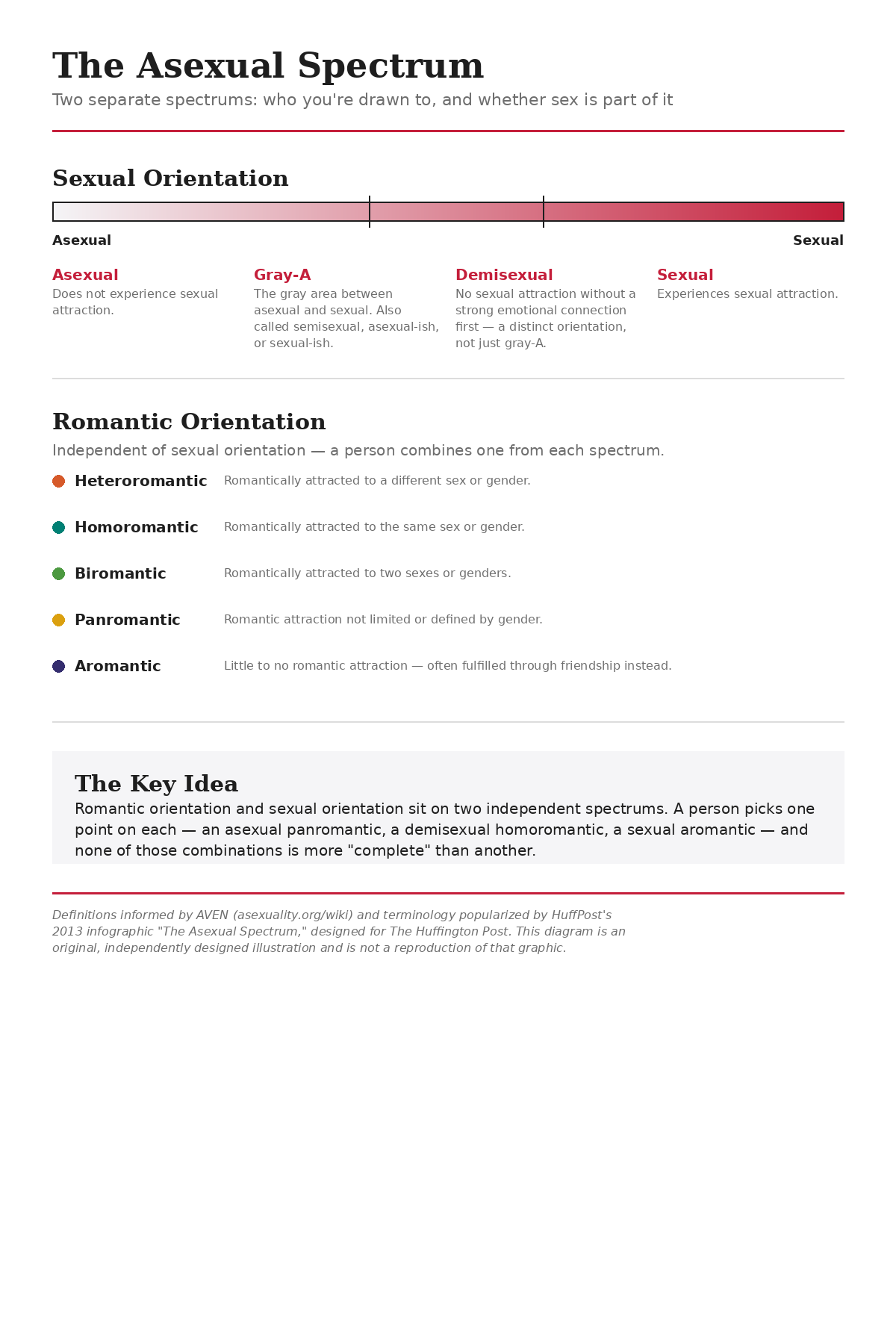
"Asexual" functions as an umbrella term covering many experiences. A few of the identities that live under it:
- Asexual: little to no sexual attraction to others, regardless of gender.
- Gray-asexual: the in-between zone. Attraction that's rare or hard to name, sitting somewhere between sexual and asexual without fitting cleanly into either.
- Demisexual: sexual attraction that only shows up after a real emotional bond is already established. This differs from being selective: the attraction itself is structured differently, with a precondition most people don't have.
Romantic orientation runs its own separate spectrum:
- Aromantic: little to no interest in romantic relationships, often with deep investment in friendship and chosen family instead.
- Panromantic: romantic attraction that isn't limited or organized around another person's gender.
Most people on the ace spectrum land somewhere specific on both spectrums: an asexual panromantic or a demisexual aromantic. The combinations are the point. There isn't one asexual experience to hold up as the template.
Where This Entered the Public Conversation
Huffington Post ran a widely shared infographic in 2013 called "The Asexual Spectrum", sourced from AVEN's wiki, mapping out several of these identities for a mainstream audience, one of the earlier moments this vocabulary reached people outside ace-specific spaces like AVEN (the Asexual Visibility and Education Network). It's worth knowing that piece exists, and worth being honest about its limits: even HuffPost's own graphic carried a note that it was a limited model of the spectrum rather than a definitive one, and that not all asexual people would agree with every definition in it. No infographic, including the one below, captures every version of this experience. That's what happens when you try to draw a map of something this individual.
Below is my own version, built to walk through the two-dial framework above:
What Relationships Actually Look Like
Part three of that same HuffPost series looked specifically at relationships and intimacy in the ace community, and the throughline is worth naming directly: asexual people date, partner up, marry, and build long-term relationships at rates that would surprise anyone still picturing asexuality as a life spent alone. What differs is the architecture. Some ace-allosexual couples negotiate sex as an act of connection rather than desire. Some asexual people masturbate and enjoy physical sensation without ever experiencing attraction to another person. Arousal and attraction are not the same mechanism, and conflating them is one of the more common mix-ups even inside sex-positive spaces. Some aces are sex-repulsed and structure relationships without it entirely. Some are indifferent and let a partner's needs guide the shape of that part of the relationship.
These are different starting points for the same conversation every couple eventually has to have: what do we want, and how do we build something honest around it instead of around what we assumed we were supposed to want.
What This Means Clinically
Clients on the ace spectrum often arrive already exhausted from having to explain themselves: to partners, to family, sometimes to previous clinicians who quietly treated asexuality as a symptom to be solved rather than an orientation to be understood. Part of the work is simply not doing that. The rest is usually relational: helping a couple figure out where their two dials sit, rather than assuming one person is broken and the other is patient. Compatibility is about both partners knowing what their own settings are, and building something honest around the real numbers instead of the assumed ones.
Asexuality is one dial, set differently than the culture expects, and the culture's expectation was always the less reliable data point.
Wondering Where You Land on the Spectrum?
If you're curious about your own relationship to sexual attraction, or you've never quite had the language for it, the Asexuality Identification Scale (AIS-12) is a validated, research-backed self-report questionnaire developed by Yule, Brotto & Gorzalka. It's designed to give a meaningful measure of asexuality regardless of whether you currently identify that way. It's not a diagnosis, and it won't tell you who you are, but it can be a useful mirror, especially if you've spent years wondering why the standard script never quite fit.
Take the AIS-12 screener on Embrace Autism →
Embrace Autism hosts one of the most thorough, research-grounded resources on the intersection of autism and the asexual spectrum. Worth a read whether or not autism is part of your picture.
Well wishes, 🙏 Love C. Dialogos, LMFT, Buddhist Chaplain
Image credit: original infographic created for this post. Definitions informed by AVEN's wiki and terminology popularized by HuffPost's 2013 "The Asexual Spectrum" graphic. Not a reproduction of that graphic.
Further reading on this site:
- Gender-Affirming Care: Surgical Provider Directory: searchable directory of gender-affirming surgical providers across the U.S. and internationally, filterable by procedure and WPATH membership
- Being Non-Monosexual: Why the Middle Makes Everyone Else Uncomfortable: biphobia and the specific pressures of non-monosexual identity
- What Hormone Therapy Does: GAHT effects and what WPATH SOC8 recommends
Explore Topics
Written by
Mx. Love C. Dialogos, LMFT
Mx. Love C. Dialogos, LMFT, is a licensed marriage and family therapist and Buddhist chaplain practicing by telehealth in 13 states. Their clinical writing has appeared in Psychotherapy Networker.
© 2026 Love Psychotherapy, LLC. All rights reserved. Love Psychotherapy® is a registered trademark.


