 ®
®What The Velveteen Rabbit Actually Teaches About Becoming Real
Margery Williams wrote a children's book about a stuffed rabbit who wants to be real. What she actually wrote was a precise account of what it costs to stop performing and start becoming — and why love is the only thing that can do it.
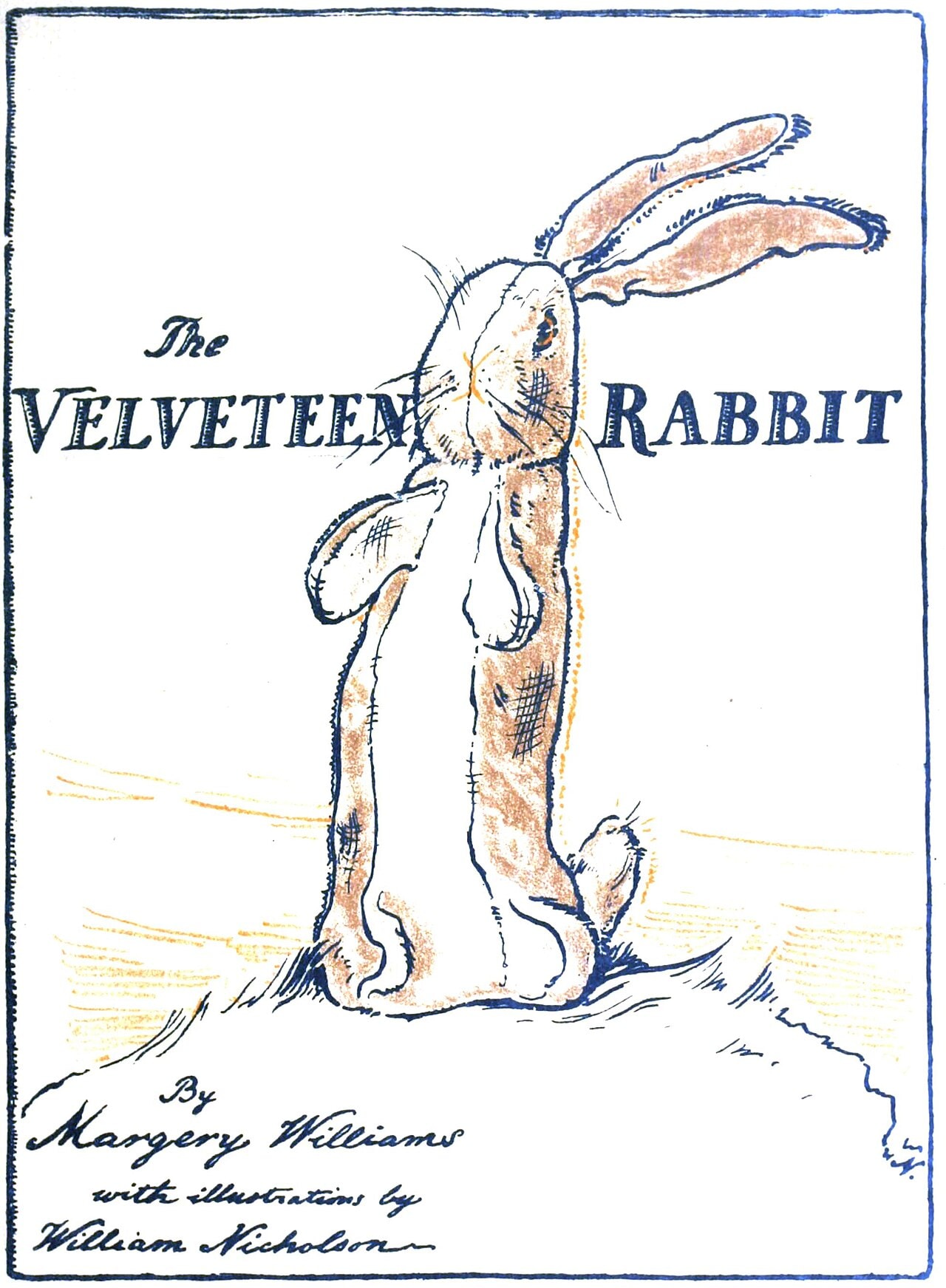
Margery Williams published The Velveteen Rabbit in 1922. It is, on its surface, a story about a stuffed toy rabbit who wants to become real. It is, underneath that surface, one of the most precise accounts of what authenticity actually costs that I have ever read — and it was written for children.
The Rabbit arrives in a boy's Christmas stocking and is immediately overshadowed by more impressive toys. He is made of velveteen. He is not mechanical. He cannot do anything the other toys can do. He is, in the taxonomy of the nursery, not much.
He asks the Skin Horse — the oldest, most worn toy in the room — what it means to be real.
The Skin Horse's answer is worth sitting with directly:
"Real isn't how you are made. It's a thing that happens to you. When a child loves you for a long, long time, not just to play with, but REALLY loves you, then you become Real."
And then, when the Rabbit asks if it hurts:
"Sometimes. When you are Real you don't mind being hurt."
The Thing Nobody Tells You About Becoming Real
The story does not promise that becoming real is comfortable. It promises that it is worth it — and those are not the same promise.
The Rabbit becomes real through being loved. Not through performing correctly. Not through being the most impressive toy in the room. Not through having the right features or the right mechanisms. Through being chosen, repeatedly, by someone who sees him and keeps coming back.
This is, clinically, a description of secure attachment. It is also a description of what happens in good therapy. And it is a description of what many of my clients — particularly those who are neurodivergent, queer, or both — have spent years being told they cannot have, because they are not the right kind of real.
What Masking Costs
Many of the people I work with learned early that their natural way of being in the world was not acceptable. Too much. Too loud. Too intense. Too queer. Too strange. Too needy. Too everything.
So they learned to perform a version of themselves that was more tolerable to the people around them. They got very good at it. Some of them got so good at it that they stopped knowing, for long stretches of time, what they actually were underneath the performance.
This is masking. And it works, in the short term, in the same way that the Rabbit's velveteen surface works in the short term: it gets you through the room. It keeps you from being discarded. It lets you survive the nursery.
But it is not the same as being real. And the cost of it — the exhaustion, the dissociation, the grief of not being known — accumulates.
The Skin Horse is worn. His coat is rubbed thin. His tail has lost its hair. He has been loved so thoroughly that the evidence of it is written all over his body. He is not less real for this. He is more real. The wearing is the proof.
What Love Actually Does
The Rabbit does not become real by deciding to be real. He does not become real by trying harder or performing better or finally getting the mechanics right. He becomes real because a child loves him — genuinely, consistently, over time — and that love changes what he is.
This is not a passive process. The Rabbit has to stay. He has to keep showing up in the relationship even when he is uncertain, even when the other toys are more impressive, even when he does not know yet what he is becoming. He has to tolerate the not-knowing.
But the transformation itself is not something he can manufacture. It comes from being seen and chosen, again and again, by someone who is not performing either.
This is what good relationships do. This is what good therapy does. Not fix you. Not make you into something you were not. Make it possible for you to become more fully what you already are — which is a different thing entirely, and a harder one to describe, and the only thing that actually works.
The Part That Hurts
There is a moment in the story when the Rabbit is taken away to be burned — because the boy has been ill, and the doctor has ordered all his old toys destroyed to prevent reinfection. The Rabbit, in the bag waiting to be burned, cries a real tear. And from that tear, a flower grows. And from that flower, the nursery magic comes.
Williams does not spare the reader this part. The becoming real requires passing through the moment of apparent loss. The thing that looked like an ending is what makes the transformation possible.
I do not think this is accidental. I think Williams understood something about the structure of growth that a great deal of contemporary self-help culture still resists: you do not get to skip the part that hurts. The hurt is not a detour from the becoming. It is part of the path.
A Reading
Below is a short reading from the book. The full reading is embedded above — I read the whole thing, start to finish, because some books deserve that.
If you have not read The Velveteen Rabbit since you were a child, or if you have never read it at all, I hope you will. It is short. It will take you twenty minutes. And it will tell you something true about what you are in the process of becoming.
Explore Topics
Written by
Mx. Love C. Dialogos, LMFT
Content creator and writer sharing insights and stories.
Get new articles by email
Clinical writing on neurodivergence, queerness, and mental health.
One email when something new is published. No marketing, no noise.
© 2026 Love Psychotherapy, LLC. All rights reserved. Love Psychotherapy® is a registered trademark.